
HomeSlides and problem sets
Slides and problem sets
Lecture slides and weekly problem sets are most of what a mathematics course hands out. Both come back as a tagged PDF and a web page, and both keep the shape the lecturer gave them.
A deck of 3 frames
A short Beamer deck: a title frame, a rule, and an example whose points appear one at a time in the lecture. The PDF has 3 pages, one for each frame; the web page has 3 sections, each frame's title a heading a screen reader can jump to.

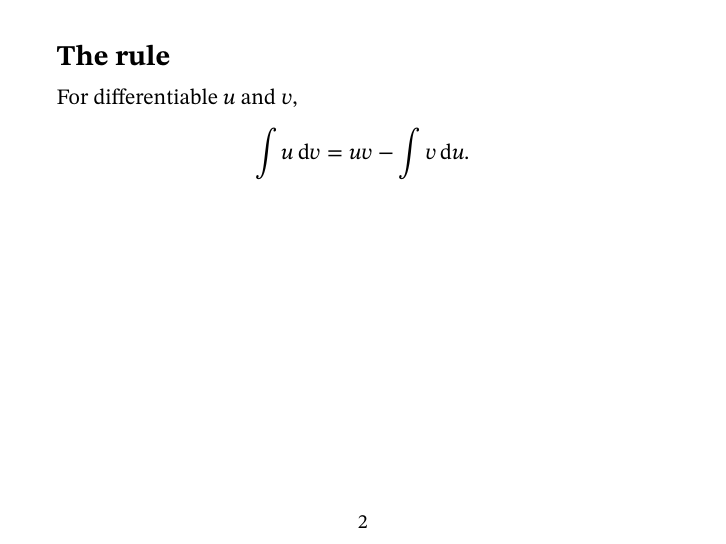
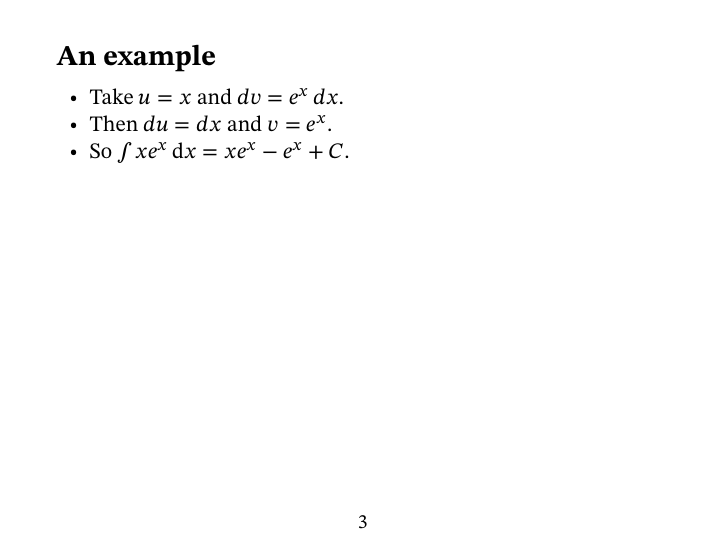
The third frame uncovers its points one by one when it is presented. In the PDF and on the page it appears once, with every point, which is what a student revising from the slides needs.
A problem set that keeps its parts
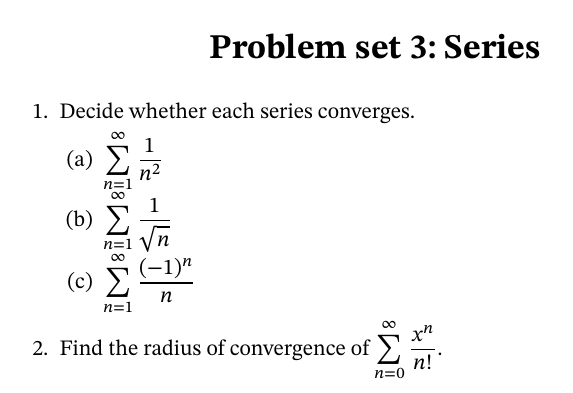
Question 1 has parts (a), (b) and (c); question 2 stands alone. On the web page they are lists inside a list, so a screen reader announces three parts inside question 1 and keeps each label, the way a student will cite them in an answer.
Problem set 3: Series
Decide whether each series converges.
- (a)
- (b)
- (c)
- Find the radius of convergence of .
Formulas in the questions
Every formula in the problem set is mathematics in both documents, with its words. Part (b) is read as the sum from n equals 1 to infinity of the fraction with numerator 1 and denominator the square root of n end fraction, so a student listening hears that the root sits in the denominator before starting the problem.
Why the shape matters
Slides are often posted as the only record of a lecture, and problem sets are graded against their part labels. A page that loses the frame titles, or turns (a), (b), (c) into one paragraph, is readable but not usable. Read more in the notes on slides as documents and problem sets that keep their parts.